The CarePoint Marriage Assessment
A clear, honest picture of the two of you
Whether you're preparing for marriage or renewing one, our proprietary assessment shows you what you're building, how you handle each other, and the next conversations worth having — with a path forward you can actually walk.
For engaged & married couples · 8 tracks · 89 core scales · a 34-page couple report
Your Couple Report
Relationship Snapshot
- CommunicationStrength
- CommitmentStrength
- FinancesSee differently
- Roles at homeStable
- Extended familyGrowth area
Sample snapshot. Every report opens with your strengths — never a score to be ashamed of.
Two Editions, Eight Tracks
Wherever your marriage is, there's a track for it
The same trusted core, shaped to your season. Three answers at the start (engaged or married, married before or not, children or not) plus military service route you to one of eight tracks. Each track changes what you're asked, how your numbers are read, and what appears in your report.
For engaged & seriously dating couples
Preparing
Start your marriage with clarity instead of assumptions. Surface the conversations most couples don't have until they're already married.
- Expectation alignment
- Relationship history
- Engagement-season stress
For married couples
Renewing
Take an honest read on where your marriage is now — in any season — and get a clear, hopeful path forward that builds on your strengths.
- Trust and repair
- Life-stage transitions
- Blended-family and caregiving load
Preparing
Track 1Premarital
Engaged or seriously dating, neither married before, no children.
Changes: Satisfaction runs high before a wedding, so it is reported but not scored against married norms. The Part C patterns carry the weight instead.
Preparing
Track 2Premarital with children
Engaged or dating, one or both have children, neither married before.
Changes: Everything on the Premarital track, plus parenting is scored as current practice, not as expectation.
Preparing
Track 3Premarital, married before
Engaged or dating, one or both divorced, no children.
Changes: Constraint commitment is read against a remarriage baseline: divorced partners often score lower on constraint and higher on dedication, and that is healthy, not a warning.
Preparing
Track 4Premarital, married before, with children
Engaged or dating, one or both divorced, one or both have children. The full stepfamily launch.
Changes: Combines the Married-before and With-children reads.
Renewing
Track 5Married
Married, first marriage for both, no children at home.
Changes: The baseline track: every number is read against married norms with no adjustment.
Renewing
Track 6Married, married before
Married now, one or both married before. Children from a prior marriage may be in the home.
Changes: Satisfaction and stability are read against a remarriage baseline, and the years-married clock includes the stepfamily timeline (most stabilize between years four and seven).
Renewing
Track 7Married with children
Married, first marriage for both, raising children together.
Changes: If the youngest child is under three, satisfaction is read against the transition-to-parenthood curve: a dip of up to a point is expected and is not flagged.
Renewing
Track 8Military family
One or both serving, active or reserve. Combines with any of the tracks above.
Changes: Every number is read against the deployment phase the couple marks. During deployment and the first three months home, a satisfaction or intimacy dip is expected and reported as "reintegration", not as a growth area.
Military family layers on top of any other track. Every track keeps the same core and the same rules: strengths first, three honest reads, never more than three growth areas. See what each track adds in What the assessment asks.
The Idea at the Center
Your marriage isn't a compatibility score
Your history and your stress don't strike your marriage directly. They travel through the way you handle each other — and that pattern is the thing you can change. It's a more honest picture, and a far more hopeful one.
What you each bring
Your history
Family patterns, attachment, temperament, and the residue of the past.
What's pressing on you
Your stress
Money, work, health, family, ministry — the real weight of this season.
How you handle each other
Your patterns
How you start hard conversations, repair after conflict, and turn toward each other day to day.
The part you can change
What you're building
Your marriage
Satisfaction, commitment, shared meaning — the fruit of the patterns above.
Because of this, the assessment never says “this score means your marriage is in trouble.” It says “this is real, here's how your patterns handle it, and here's what to work on.”
Why It's Different
Agreement is only half the story
Most assessments tell you whether you agree. This one also tells you how you handle it when you don't — and those two answers together change everything.
A shared strength
Aligned, and you handle it with grace.
Tend the pattern
You agree on the what — the how needs some care.
A manageable difference
You don't fully agree, but you handle it well.
Start here
You see it differently and the pattern strains.
How much you agree
It separates what you disagree about from how you handle it
Two couples can disagree about money in completely different ways. Ours is the report that can say “you see this differently, and you handle disagreement well — that's manageable,” instead of just flagging the disagreement.
It listens to both of you
You each complete it privately, and the report reveals where you're aligned and where you're quietly describing two different marriages. Often that gap is the most useful finding of all.
Strengths come first — always
Every couple report opens with at least three real strengths, because those are the resources you'll use for everything else. And it never lists more than three growth areas at once.
It asks about covenant, not just compatibility
A question most inventories never ask: do you both understand marriage the same way? Two people can share a wedding and a vocabulary while holding very different beliefs about the bond itself.
What It Measures
89 core scales, 154 in the full bank, in 25 modules arranged the way a marriage actually works
What you each bring
The history and wiring each of you carries in — family patterns, attachment, temperament, and the past. Slow to change, powerful to understand.
- Covenant & mindset
- Wellbeing
- Family of origin
- Attachment
- How you're wired
- Enhancements: DISC, Big Five, and the Marriage Motives Profile
- Marriage after divorce
What's pressing on you
The real weight of this season: money, work, health, extended family, and ministry load. Named as circumstance, never as failure.
- Stress load
- Social life & support
- Finances
- Roles & expectations
- Time & leisure
- Before the wedding
- Children entering the marriage
- Blending a family
- Parenting together
- Military life
How you handle each other
Your day-to-day patterns — how conversations start, how you repair, how you turn toward each other. The primary place growth happens.
- The four patterns
- Conflict
- Communication
- Love & intimacy
- Love languages
- Spiritual life
What you're building
Satisfaction, commitment, and shared meaning — the fruit of everything above, and the direction you're heading together.
- Satisfaction, commitment & meaning
- Harmony chart
See what each module asks in What the assessment asks, below.
Seven Everyday Areas
Three honest reads on the things you live every day
A single “finances score” tells you nothing you can use. Each area gets three reads — what you agree on, what's pressing on it, and how you handle it. Tap through a few.
Tap any area to see its three reads
Same agreement score, completely different meaning — that's the whole point.
Now viewing
Finances
What you agree on
How much to save, what counts as a purchase worth discussing, how much to give, and who manages the day-to-day money.
What's pressing on it
Whether financial strain is pressing on you right now.
How you handle it
How you make decisions together and support each other under pressure.
You can disagree about money and still handle it beautifully. This tells you which.
What the Assessment Asks
Real questions, and what each one becomes in your report
Each of you answers privately. Some items are agree-or-disagree. Others ask you to rank your needs, mark who does what at home, or choose the words that fit you best. A sample item from every module is below. Tap any module to open it.
What you each bring
In your report: Where each of you sits on the covenant-to-cautious spectrum, and how your two views mesh.
Written to: Stanley & Markman (1992), Commitment Inventory: dedication vs. constraint commitment. · Rhoades, Stanley & Markman (2010), commitment and the odds of staying together. · Mahoney et al. (1999), sanctification of marriage.
- View of the bondAgree / disagree
“Marriage is a promise made before God, not an agreement that lasts while it works.”
- “If a marriage stops working, ending it is a reasonable option. (R)”
- “I see our marriage as something God joined, not something we can undo.”
- DedicationAgree / disagree
“I want this marriage to have a long future, and I make choices with that future in mind.”
- “I think of us as a team, not as two people who happen to be together.”
- “I'd give up things I want for the good of our marriage.”
- ConstraintAgree / disagree
“If I'm honest, some of what keeps me here is what leaving would cost.”
- “I've invested too much in this marriage to walk away now.”
- “Leaving would mean starting over financially, and that keeps me here.”
- Expectation of growthAgree / disagree
“I expect our marriage to be a place I become more like Christ, not just a place I'm comfortable.”
- “A good marriage should change me for the better, and I welcome that.”
- “Marriage is mostly about being happy. (R)”
- View of remarriageAgree / disagreePremarital, married before · Premarital, married before, with children · Married, married before only
“I have settled, with God and with my church, what I believe about marrying again.”
- “I still carry guilt about marrying again. (R)”
- “My church community knows about this marriage and supports it.”
In your report: An individual wellbeing percentage for each of you, a marriage wellbeing score, and private caution flags for your counselor.
Written to: Rosenberg (1965), Self-Esteem Scale (self-concept). · Davis (1983), Interpersonal Reactivity Index, perspective-taking and empathic concern. · Bowen, differentiation of self; Skowron & Friedlander (1998), DSI. · Smith et al. (2008), Brief Resilience Scale. · Rempel, Holmes & Zanna (1985), Trust in Close Relationships. · Screens (private): PHQ-2, GAD-2 (Kroenke), AUDIT-C, HITS (Sherin 1998) for partner violence.
- Self-conceptAgree / disagree
“Most days I feel sure of who I am and what I bring.”
- “I often feel I'm not good enough. (R)”
- “I can list my strengths without hesitating.”
- EmpathyAgree / disagree
“I can usually tell what my spouse is feeling before they say it.”
- “When we disagree, I try to see it from my spouse's side before I answer.”
- “I find it hard to understand why my spouse gets upset. (R)”
- Healthy autonomyAgree / disagree
“I make decisions from inside our marriage, not around it or in reaction to my parents.”
- “I still need my parents' approval for big choices. (R)”
- “Old hurts from my childhood rarely drive how I react to my spouse.”
- ResilienceAgree / disagree
“When something goes wrong that I can't control, I recover my footing fairly quickly.”
- “It takes me a long time to get over a setback. (R)”
- “I can usually find a next step even when a plan falls apart.”
- TrustAgree / disagree
“I can count on my spouse's word without checking.”
- “I sometimes wonder whether my spouse is telling me everything. (R)”
- “I feel safe telling my spouse the things I'm least proud of.”
- StabilityAgree / disagree
“Our marriage feels consistent and dependable from week to week.”
- “We swing between very good and very bad stretches. (R)”
- “I can predict, most days, how my spouse will treat me.”
- Caution flagsPrivate · counselor only
“In the last year, have you struggled with any of the following? (Anxiety, anger, sleep, body image, online activity, substances, past abuse.)”
- “PHQ-2: Over the last two weeks, how often have you felt down, depressed, or hopeless? Little interest or pleasure in doing things?”
- “GAD-2: Feeling nervous, anxious, or on edge? Not being able to stop or control worrying?”
- “AUDIT-C: How often do you have a drink containing alcohol? How many on a typical day?”
- SafetyPrivate · counselor only
“Have you ever felt afraid of your partner, or been hurt physically or sexually by them?”
- “HITS: How often does your partner physically hurt you, insult you, threaten you with harm, or scream at you?”
- “Is there anything in your home right now that makes you feel unsafe?”
- Suicide risk screenPrivate · counselor only
“In the past month, have you wished you were dead or wished you could go to sleep and not wake up?”
- “Have you actually had any thoughts of killing yourself?”
- “Have you been thinking about how you might do this?”
- “Have you had these thoughts and had some intention of acting on them?”
- “Have you started to work out or worked out the details of how to kill yourself? Did you intend to carry out this plan?”
- “Have you ever done anything, started to do anything, or prepared to do anything to end your life? If yes, was this within the past three months?”
- “PHQ-9 item 9: Over the last two weeks, how often have you had thoughts that you would be better off dead, or of hurting yourself?”
Columbia Protocol (C-SSRS) screener. A yes to item 2 opens items 3–5; item 6 is always asked. Any yes to items 3–6 = same-day counselor contact and the safety plan before any joint session. Never shown to the partner.
- Infidelity & secretsPrivate · counselor only
“During this relationship, have you been emotionally or sexually involved with someone else?”
- “Is there anything your partner does not know that would change this marriage if they did?”
- “Have you hidden money, debt, or spending from your partner? (financial infidelity)”
- “Is there someone in your life your partner would not want you talking to the way you do?”
- Substance & gamblingPrivate · counselor only
“AUDIT-C: How often do you have a drink containing alcohol? How many on a typical day? How often six or more?”
- “In the past year, how many times have you used an illegal drug or a prescription medication for non-medical reasons? (NIDA single-item screen)”
- “Lie/Bet: Have you ever had to lie to people important to you about how much you gamble? Have you ever felt the need to bet more and more money?”
- Mental health historyPrivate · counselor only
“Have you ever been diagnosed with or treated for depression, anxiety, bipolar disorder, PTSD, an eating disorder, or another mental health condition?”
- “Are you currently taking medication for mood, anxiety, sleep, or attention?”
- “Have you ever been hospitalized for a mental health reason?”
- “Have you seen a counselor before, alone or as a couple? What helped, and what didn't?”
- “Is there a history of suicide, addiction, or serious mental illness in your family?”
- Pregnancy, fertility & lossPrivate · counselor only
“Are you currently pregnant, trying to conceive, or facing infertility?”
- “Have you experienced a miscarriage, stillbirth, or abortion? Does your partner know?”
- “Is there a pregnancy, past or present, that still weighs on you?”
In your report: A closeness-by-flexibility map of the home each of you came from, and the patterns you carried in.
Written to: Olson (2000, 2011), Circumplex Model; FACES IV cohesion and flexibility dimensions. · Hovestadt et al. (1985), Family-of-Origin Scale.
- ClosenessAgree / disagree
“In my home growing up, we knew what was going on in each other's lives.”
- “In my family, people were expected to have no life outside the family. (R, enmeshment)”
- “Growing up, we mostly went our own ways. (R, disengagement)”
- FlexibilityAgree / disagree
“In my home growing up, rules changed when circumstances changed.”
- “In my family there was one right way to do things and it never changed. (R, rigid)”
- “Nobody was really in charge in my home growing up. (R, chaotic)”
- Conflict scriptAgree / disagree
“In my home growing up, disagreements were talked through openly.”
- “When my parents were upset with each other, everyone knew it and nobody said it.”
- “Raised voices were normal in my home.”
- Faith in the homeAgree / disagree
“Faith was practiced, not just professed, in the home I grew up in.”
- “We prayed together as a family growing up.”
- “What my parents believed and how they lived were two different things. (R)”
In your report: Secure, anxious, and avoidant scores for each of you, and the loop the two of you tend to fall into.
Written to: Hazan & Shaver (1987), romantic love as attachment. · Fraley, Waller & Brennan (2000), ECR-R anxiety and avoidance dimensions. · Johnson (2004), EFT pursue–withdraw cycle.
- SecureAgree / disagree
“I'm comfortable depending on my spouse and having my spouse depend on me.”
- “I don't worry much about being abandoned.”
- “I find it easy to get close to my spouse.”
- AnxiousAgree / disagree
“When my spouse pulls back, I worry they don't love me as much as I love them.”
- “I need a lot of reassurance that I'm loved.”
- “I get frustrated when my spouse isn't available when I need them.”
- AvoidantAgree / disagree
“When things get tense, I'd rather have space than talk it through.”
- “I prefer not to show my spouse how I feel deep down.”
- “I get uncomfortable when my spouse wants to be very close.”
In your report: Your relating style on the eight-petal wheel, your four style bars, strengths you bring, and how your spouse experiences you under stress.
Written to: Marston (1928) / DISC pace-and-focus axes, re-expressed as two continuous dimensions (pace, focus) rather than four types. · Big Five markers for extraversion and conscientiousness (Goldberg 1992) as validity anchors for pace and focus. · Gottman, conflict styles (validator, volatile, avoider) for the problem-solving bar.
- PaceChoose
“Choose the word that fits you best in each pair: deliberate / quick, steady / spontaneous…”
- “I make up my mind quickly and act.”
- “I'd rather take my time than be first.”
- FocusChoose
“Choose the word that fits you best in each pair: task / people, results / relationships…”
- “Getting it done matters more to me than how everyone feels about it.”
- “I notice how people are doing before I notice what got done.”
- Solving problemsAgree / disagree
“When there's a problem, I'd rather think it over first than talk it out first.”
- “I say what I think about a problem as soon as I think it.”
- “I sit with an issue for a while before raising it.”
- Influencing each otherAgree / disagree
“I persuade my spouse more with facts than with feelings.”
- “When I want my spouse to see it my way, I explain how it makes me feel.”
- “I lay out the reasons and let them speak for themselves.”
- Reacting to changeAgree / disagree
“A sudden change of plans is more annoying than exciting to me.”
- “I like trying new things without much notice.”
- “I need time to warm up to a change.”
- Making decisionsAgree / disagree
“I'd rather decide now and adjust later than wait until I'm sure.”
- “I rarely regret a quick decision.”
- “I gather more information than most people before I choose.”
- Under stressChoose
“When I'm under pressure, my spouse would say I become… (choose three).”
- “When I'm stressed I get quieter than usual.”
- “When I'm stressed I get sharper than usual.”
In your report: Optional add-ons ordered at intake and taken inline. Each becomes a two-page section: your profiles with marriage-specific readings, your pairing's gifts and traps, and bridges written for the two of you. Items and scoring are CarePoint's licensed instruments (lib/personality-enhancements.ts); the relationship context is CarePoint's own.
Written to: DISC (Marston 1928; modern instruments e.g. Everything DiSC, PeopleKeys): moderate reliability, widely used, four styles on the same two axes as the CarePoint wheel. · Big Five Inventory (BFI-44; John & Srivastava 1999): the best-validated personality model in psychology. Four of the five traits predict a partner's relationship satisfaction (Malouff et al. 2010). · Marriage Motives Profile (MMP-105, v2.0 pilot; CarePoint original): nine motive patterns in marriage, each anchored to attachment, conflict, and personality research (Rusbult accommodation, Christensen demand–withdraw, Mikulincer & Shaver attachment, Gottman, Aron self-expansion, Fritz & Helgeson unmitigated communion). Transparent facet-weighted scoring, no validation claim yet; results are a hypothesis the participant confirms; never scored into a CarePoint result. · None of the three is used to compute any CarePoint score. All are optional, taken inline, and administered under CarePoint's license.
- DISC profileCounselor-entered
“Licensed DISC items, taken by each partner inline; scored to D, I, S, C by the licensed scoring.”
- “Mapped to the wheel: D → Director / Initiator, I → Energizer / Encourager, S → Harmonizer / Anchor, C → Steward / Analyst.”
- “Report shows agreement with the wheel and names any mismatch as a talking point, not a correction.”
- Marriage Motives Profile patternCounselor-entered
“105 MMP items about behavior with one's spouse (1 strongly disagree – 5 strongly agree), taken by each partner inline; 21 motive scores and nine weighted pattern-match scores; primary = highest, secondary within 8 points.”
- “Report shows all nine match scores, the strongest and quietest motives, core desire and fear, strengths and blind spots, the research anchor, the formation invitation with practices and Scripture, pressure and formation connections, and a pairing read.”
- “Participant verifies or corrects the computed pattern; both are stored. Never scored into any CarePoint result.”
- Big Five profileCounselor-entered
“BFI-44 items, taken by each partner inline; scored to trait means on the 1–5 scale and banded against adult norms.”
- “Report shows each trait with a marriage-specific reading and a trait-by-trait pairing read.”
- “Traits are described as tendencies; the couple's own patterns (Part C) always take precedence.”
In your report: What each of you carries from a marriage that ended: grief, forgiveness, trust, and the fear of repeating it. Private items go only to your counselor.
Written to: Kitson (1992), divorce adjustment; Fisher Divorce Adjustment Scale. · Worthington (2003), REACH forgiveness; Enright Forgiveness Inventory constructs. · Olson & Olson (2000), remarriage problem areas (PREPARE-MC).
- What ended itPrivate · counselor only
“In your own words, what ended your previous marriage, and what part was yours?”
- “Has your former spouse's account of what happened ever changed how you see your part?”
- “What have you done differently since, on purpose?”
- Time sinceChoose
“How long has it been since your divorce was final?”
- “Less than 1 year / 1–2 years / 2–3 years / more than 3 years.”
- Grief & closureAgree / disagree
“I have grieved the end of my previous marriage rather than just moved past it.”
- “I still get caught off guard by sadness about my first marriage. (R)”
- “I can talk about my divorce without it taking over the conversation.”
- ForgivenessAgree / disagree
“I have forgiven my former spouse, even where reconciliation isn't possible.”
- “I still want my former spouse to pay for what they did. (R)”
- “I can wish my former spouse well and mean it.”
- Fear of repeatingAgree / disagree
“I catch myself watching for the same warning signs I missed last time.”
- “When my partner does something my ex used to do, I react to my ex, not to my partner.”
- “I trust that this marriage is a different marriage.”
- Trust rebuiltAgree / disagree
“I can trust my partner fully without my history getting in the way.”
- “I check up on my partner more than I'd like to admit. (R)”
- “My partner has earned a trust my history tried to talk me out of.”
- Contact with a former spouseChoose
“How often are you in contact with your former spouse, and about what?”
- “My partner knows every time I'm in contact with my former spouse.”
- “Contact with my former spouse stays about the children and logistics.”
- Financial tiesAgree / disagree
“Support payments, shared debts, or assets from my previous marriage are settled and known to my partner.”
- “Money from my previous marriage still causes tension between us. (R)”
- “We have a written plan for what my previous marriage still costs.”
- Faith & remarriageYes / no
“I have talked with a pastor about remarriage and feel at peace about it.”
- “Our church knows our story and has blessed this marriage.”
What's pressing on you
In your report: A slider for each pressure of this season, with both of your marks, and a load rating for each of you.
Written to: Cohen, Kamarck & Mermelstein (1983), Perceived Stress Scale. · Karney & Bradbury (1995), stressful events in the VSA model; Neff & Karney (2004), external stress and marital quality. · Holmes & Rahe (1967), life-events weighting (used for the load rating).
- MoneyRate 1–10
“Right now, money is a source of ongoing stress for me.”
- “I've lost sleep over money in the last month.”
- “We could handle a $1,000 surprise expense without a crisis. (R)”
- Work & scheduleRate 1–10
“My work hours or commute leave less of me for home than I want.”
- “I bring work stress home more days than not.”
- “My schedule and my spouse's rarely line up.”
- Parenting loadRate 1–10Premarital with children · Premarital, married before, with children · Married with children only
“The daily care of our children falls more heavily on me than I can sustain.”
- “I feel like I'm parenting alone most days.”
- “By evening I have nothing left for my spouse.”
- Extended familyRate 1–10
“Expectations from extended family press on our marriage.”
- “A family member's needs are pulling on my attention this season.”
- “Holidays with family cause tension between us.”
- Health & energyRate 1–10
“Sleep, health, or energy are limiting me this season.”
- “I get less than six hours of sleep most nights.”
- “A health issue, mine or a family member's, is weighing on me.”
- Ministry & serviceRate 1–10
“My church or volunteer commitments are more than I can carry well right now.”
- “Serving refills me more than it drains me. (R)”
- “My spouse has asked me to cut back on church commitments.”
- Wedding & transitionRate 1–10Premarital · Premarital with children · Premarital, married before · Premarital, married before, with children only
“Planning the wedding and setting up a home is weighing on me.”
- “Wedding decisions have caused real conflict between us or with family.”
- “I'm more excited about the marriage than the wedding. (R)”
- Military tempoRate 1–10Military family only
“Training, duty hours, or an upcoming move are pressing on our home right now.”
- “We've moved in the last eighteen months.”
- “A deployment or long field time is likely in the next year.”
In your report: Four sliders showing how content each of you is with family, in-laws, friends, and your faith community.
Written to: Zimet et al. (1988), Multidimensional Scale of Perceived Social Support. · Bryant & Conger (1999), network support and marital success.
- Family relationshipsAgree / disagree
“I'm content with my relationship with my own family.”
- “There is a family member I avoid. (R)”
- “My family is a source of support for our marriage.”
- In-lawsAgree / disagree
“I feel welcome and respected by my spouse's family.”
- “My spouse's family oversteps and my spouse doesn't stop it. (R)”
- “I would call my in-laws if I needed help.”
- Mutual friendsAgree / disagree
“We make time with friends a priority, and I feel good about my spouse's friendships.”
- “I have a friend I could tell anything to.”
- “My spouse's friends pull my spouse away from our marriage. (R)”
- Faith communityAgree / disagree
“The people we worship with are a real part of our support.”
- “We have a couple at church we could call in a crisis.”
- “We attend but we don't really belong. (R)”
- Support where we're stationedAgree / disagreeMilitary family only
“We have people near us we could call at 2 a.m.”
- “We've found a church or chaplain since our last move.”
- “The family readiness group is a real help to us.”
In your report: Your money matrix: money style, budget skills, financial fears, and debt, plus six money-talk sentence starters.
Written to: Klontz et al. (2011), Money Scripts Inventory (money style and fears). · Dew & Dakin (2011), financial disagreements as the strongest predictor of divorce among topics. · Archuleta et al. (2013), Financial Anxiety Scale.
- Money styleChoose
“When money comes in, my first instinct is to… (save it / enjoy some of it).”
- “I feel guilty when I spend on myself.”
- “I'd rather enjoy money now than pile it up for later.”
- Budget skillsChoose
“Which best describes you? (We keep a budget and I check it / I've started one but didn't stick to it / We don't keep one.)”
- “I know, within $100, what's in our checking account right now.”
- “We review our spending together at least monthly.”
- Financial fearsChoose
“Which of these worries you most about money? (Lack of influence, lack of security, lack of respect, not realizing dreams.)”
- “I worry that I don't have a real say in our money.”
- “I worry we'll never afford the life we hoped for.”
- DebtChoose
“How would you describe the debt you bring to or carry in this marriage?”
- “My spouse knows the full amount of my debt.”
- “Debt keeps us from decisions we'd otherwise make.”
- GivingAgree / disagree
“We agree on how much to give, and we do it.”
- “Giving is the first line in our budget, not the last.”
- “We argue about how much to give. (R)”
- Merging moneyAgree / disagreePremarital · Premarital with children · Premarital, married before · Premarital, married before, with children only
“We have agreed on what will be shared, what stays separate, and why.”
- “We've each seen the other's full financial picture: income, debts, credit.”
- “We agree on who will manage the day-to-day money.”
- Money for childrenAgree / disagreePremarital with children · Premarital, married before, with children · Married, married before only
“We agree on how children from a previous relationship are provided for, including support that goes out or comes in.”
- “Support payments are a source of resentment in our home. (R)”
- “We've agreed on what we'll spend on each child, ours and mine.”
In your report: A who-does-what grid: what you saw your mom and dad do, what you do, and what you expect of your spouse, for twenty household roles.
Written to: Cowan & Cowan (1990), Who Does What? role-division measure. · Frisco & Williams (2003), perceived fairness of housework and marital happiness.
- Household rolesWho does it
“For each task, mark who did it in your home growing up (Mom / Dad) and who does it now (Me / You): cooking, bills, yard work, discipline, praying with the children…”
- “Twenty tasks; the grid is the item.”
- Leadership at homeAgree / disagree
“When we can't agree, we have a clear and fair way to decide.”
- “One of us usually gets the final say, and we both know who. (scored with the next item)”
- “We have talked about what leadership at home means to each of us, biblically and practically.”
- FairnessAgree / disagree
“The way we divide work at home feels fair to me.”
- “I do more than my share and it isn't noticed. (R)”
- “If I got sick for a week, my spouse could run the house.”
- Roles when apartWho does itMilitary family only
“For each task, mark who carries it when one of us is deployed or in the field.”
- “We've written down what changes when one of us is away, so nobody has to guess.”
In your report: Your time style (present or future, scheduled or unscheduled) and your agreements about time together and apart.
Written to: Zimbardo & Boyd (1999), Time Perspective Inventory (present vs. future). · Johnson, Zabriskie & Hill (2006), couple leisure involvement and satisfaction.
- Time orientationAgree / disagree
“I spend more of my mind on what's coming than on what's happening.”
- “I find it hard to just be here without thinking about what's next.”
- “I rarely plan more than a few days ahead. (R)”
- SchedulingAgree / disagree
“I like my week planned in advance.”
- “A blank Saturday makes me uneasy.”
- “I'd rather leave the day open and see what happens. (R)”
- Together vs. apartChoose
“How many evenings a week do you want to be together with no screens?”
- “I get enough time alone.”
- “We have enough time as a couple, apart from work and children.”
- Use of free timeChoose
“Given a free Saturday, I'd rather… (rest at home / be with people / get something done).”
- “My spouse and I enjoy the same kinds of free time.”
- “One of us usually gives in about how we spend a day off. (R)”
In your report: How deliberately you're choosing this, what you expect marriage to be, and the practical agreements engaged couples skip.
Written to: Stanley, Rhoades & Markman (2006), sliding vs. deciding; Rhoades et al. (2009), cohabitation effect. · Olson & Olson (2000), PREPARE: idealistic distortion and realistic expectations scales. · Eidelson & Epstein (1982), Relationship Beliefs Inventory (unrealistic beliefs).
- Deciding, not slidingAgree / disagree
“We chose to marry on purpose; we didn't drift here because it was next.”
- “We talked about what marriage would mean before we talked about a date.”
- “If I'm honest, the wedding got planned before the decision felt fully made. (R)”
- Realistic expectationsAgree / disagree
“Marriage will fix the things that bother me about our relationship now. (R)”
- “My partner will change after we're married. (R)”
- “I expect us to disagree, and I expect that to be okay.”
- IdealizationAgree / disagree
“My partner has almost no faults. (R)”
- “We never really argue. (R)”
- “Every conflict we've had was easily solved. (R)”
- Living togetherChoose
“Are you living together now? If so, what led to that decision?”
- “If living together: we made that decision together, on purpose, and we know why.”
- Family planningAgree / disagree
“We agree on whether, when, and how many children we hope for, and on how we'll handle contraception.”
- “We've talked about what we'd do if we couldn't have children.”
- “We agree on what contraception we're comfortable with and why.”
- “We've talked with a doctor or pastor about contraception options.”
- “We disagree about whether to use contraception at all. (R)”
- Where we'll live & worshipAgree / disagree
“We have decided where we'll live and which church will be ours.”
- “We've talked about how far from each set of parents we want to be.”
- “We know which of our two churches, or a third, will be home.”
- Wedding vs. marriageAgree / disagree
“We've spent at least as much time preparing for the marriage as for the wedding.”
- “We've read a marriage book or taken a class together.”
- “I know what my partner expects the first year to look like.”
- Red flagsPrivate · counselor only
“Is there anything you are hoping will change after the wedding?”
- “Has anyone who loves you raised a concern about this relationship? What was it?”
- “Is there anything you haven't told your partner that they'd want to know before the wedding?”
In your report: Who parents whom, what role the new spouse will take, and how the children's other parent fits, before the wedding rather than after.
Written to: Papernow (2013), stepfamily architecture; the stepparent role and discipline authority. · Ganong & Coleman (2017), stepparent–stepchild affinity as the strongest predictor of stepfamily stability. · Feinberg (2012), Coparenting Relationship Scale (with the other parent).
- Stepparent roleAgree / disagree
“We agree on what my partner will and won't do as a parent to my children in the first year.”
- “My partner expects to be treated as a parent right away. (R)”
- “We've talked about my partner being more of an aunt or uncle figure at first.”
- Discipline authorityAgree / disagree
“In our home, the biological parent will lead discipline while the stepparent builds the relationship.”
- “I expect my partner to back me up in front of my children rather than take over.”
- “We've agreed on what my partner can correct without me there.”
- Children's readinessAgree / disagree
“My children have had a real voice in this, and I know how each of them feels about it.”
- “One of my children is against this marriage. (R)”
- “My children have spent enough time with my partner to know them.”
- Co-parenting with the other parentAgree / disagree
“The children's other parent and I can communicate about the kids without it spilling into our home.”
- “The other parent undermines our home rules. (R)”
- “We have a written parenting schedule that mostly holds.”
- Loyalty bindsAgree / disagree
“My children feel free to love my new spouse without betraying their other parent.”
- “My children have been told it's okay to like my partner.”
- “My children get quiet or angry after time with their other parent. (R)”
- Household rulesAgree / disagree
“We have written down the house rules that will apply to every child, ours and mine.”
- “We agree on bedtimes, screens, and chores for all the children.”
- “There will be one set of rules for my children and another for my partner's. (R)”
- Names & belongingChoose
“We have talked about what the children will call my spouse and what that means to them.”
- “We've talked about whether my partner would ever adopt.”
- “My children will keep their own last name and we've talked about why.”
In your report: Insider and outsider pulls, stepparent warmth, loyalty binds, and the opposite parenting styles stepfamily life creates.
Written to: Papernow (2013), the five challenges of stepfamily life. · Crosbie-Burnett (1989), Stepfamily Adjustment Scale. · Ganong & Coleman (2017); Bray & Kelly (1998), the Developmental Issues in Stepfamilies project.
- Insider / outsiderAgree / disagree
“In our home, I sometimes feel like the outsider looking in on my spouse and their children.”
- “My spouse and their children have a shorthand I'm not part of.”
- “I feel torn between my spouse and my children. (insider item)”
- Stepparent warmthAgree / disagree
“My stepchildren and I have a warm relationship that is growing on its own timeline.”
- “I have something I do one-on-one with each stepchild.”
- “My stepchildren tolerate me more than they like me. (R)”
- Parenting-style pullAgree / disagree
“I think my spouse is too easy on their children; my spouse thinks I'm too strict. (or the reverse)”
- “We argue more about the children than about anything else.”
- “I've stopped saying what I think about my spouse's parenting. (R)”
- Loyalty bindsAgree / disagree
“The children seem caught between loving me and staying loyal to their other parent.”
- “The children hide their affection for me around their other parent.”
- “The children have been told, by us, that loving both homes is allowed.”
- Couple timeAgree / disagree
“We protect time for just the two of us, apart from the children.”
- “Our marriage gets whatever is left after the children. (R)”
- “We have a weekly time that the children know is ours.”
- The other householdAgree / disagree
“Schedules, rules, and money with the children's other parent are predictable enough to live with.”
- “Exchanges with the other household leave me tense for hours. (R)”
- “We have a plan for holidays that all households know.”
- UnityAgree / disagree
“The children see the two of us as one team, even when we disagree in private.”
- “The children have learned to go around one of us to the other. (R)”
- “We decide together before we answer the children.”
In your report: Division of care, united front, faith formation, and the transition-to-parenthood dip if your children are young.
Written to: Abidin & Brunner (1995), Parenting Alliance Measure. · Feinberg (2012), Coparenting Relationship Scale. · Doss, Rhoades, Stanley & Markman (2009); Gottman & Gottman, Bringing Baby Home: friendship rituals as the protective factor.
- Division of careAgree / disagree
“The daily care of our children is shared in a way we both chose.”
- “I keep the mental list of everything the children need, and my spouse doesn't know it exists. (R)”
- “We've renegotiated who does what since the last child was born.”
- United frontAgree / disagree
“We back each other up in front of the children and settle disagreements in private.”
- “The children know which parent to ask to get a yes. (R)”
- “When I disagree with how my spouse handled something, I wait until we're alone.”
- DisciplineAgree / disagree
“We agree on how we discipline and why.”
- “One of us is the enforcer and the other the comforter, and it's causing friction. (R)”
- “We have talked about how we were each disciplined and what we'll keep.”
- Faith formationAgree / disagree
“We are intentional about praying with and teaching our children.”
- “Our children see us pray.”
- “Faith at home is something we mean to get to. (R)”
- Couple timeAgree / disagree
“We have kept some rituals that are just ours since the children came.”
- “We've had a night out without the children in the last month.”
- “Our conversations are almost all about the children. (R)”
- Friendship since babyAgree / disagree
“We still feel like friends, not just co-managers of a household.”
- “My spouse still knows what's going on inside me.”
- “I miss who we were before children. (R)”
- Sharing the load at nightAgree / disagree
“When the children need us at night, we have a fair way of deciding who goes.”
- “One of us is chronically more tired than the other and we both know why. (R)”
- “We protect each other's sleep on purpose.”
In your report: Where you are in the deployment cycle, how you stay connected apart, how you renegotiate roles on return, and the supports around you.
Written to: Vogt et al. (2013), Deployment Risk and Resilience Inventory-2 (family and post-deployment scales). · Knobloch & Theiss (2012), relational turbulence during reintegration. · Boss (2007), ambiguous loss; Pincus et al. (2001), emotional cycle of deployment. · Screens (private): PC-PTSD-5 (Prins 2016).
- Deployment phaseChoose
“Where are you right now? (No deployment in view / preparing / deployed / home within six months / reintegrated.)”
- “How many deployments or long separations has this marriage been through?”
- Connection while apartAgree / disagree
“When we're apart, we have a rhythm for staying in touch that works for both of us.”
- “Calls while apart tend to turn into arguments. (R)”
- “We know what not to bring up over a bad connection.”
- Role renegotiationAgree / disagree
“When my spouse comes home, handing roles back and forth goes smoothly.”
- “I run the house my way while my spouse is gone and it's hard to give it back. (R)”
- “We talk about who does what before the homecoming, not after.”
- Reintegration turbulenceAgree / disagree
“The first weeks home are harder on our marriage than the deployment itself.”
- “We expect the first month home to be bumpy and we don't panic about it.”
- “I feel like a guest in my own home when I first get back. (R)”
- Ambiguous lossAgree / disagree
“Even when my spouse is home, part of them still seems away.”
- “I've grieved things about my spouse that service changed.”
- “We can talk about what deployment took from us.”
- Moves & careerAgree / disagree
“Our moves have cost one of us a career, and we have talked honestly about that.”
- “I resent what the military has cost my work or education. (R)”
- “We decide together whether to stay in or get out.”
- Chaplain & faith supportAgree / disagree
“We have a chaplain or church we can turn to where we're stationed.”
- “We found a church within three months of our last move.”
- “We've talked to a chaplain about our marriage at least once.”
- Injury, trauma & sleepPrivate · counselor only
“Since service, have you struggled with sleep, anger, flashbacks, or a service-connected injury?”
- “PC-PTSD-5: In the past month, have you had nightmares about the event(s) or thought about them when you did not want to? Tried hard not to think about them? Been constantly on guard? Felt numb or detached? Felt guilty or unable to stop blaming yourself?”
- Children & absenceAgree / disagree
“Our children handle a parent's absence and return without it costing our marriage.”
- “The children's behavior around homecoming strains us as a couple. (R)”
- “We prepare the children for goodbyes and for homecomings on purpose.”
How you handle each other
In your report: Both of your scores on soft start-up, repair, turning toward, and sharing power. The heart of the report.
Written to: Gottman & Levenson (1992); Gottman (1999), Sound Relationship House: harsh start-up, repair attempts, turning toward, accepting influence. · Gottman Relationship Checkup constructs (Gottman Institute), re-expressed as original items. · Christensen & Sullaway (1984), Communication Patterns Questionnaire (demand–withdraw).
- Soft start-upAgree / disagree
“When I bring up something hard, I start with what I need, not with what my spouse did wrong.”
- “My spouse would say I open hard conversations with criticism. (R)”
- “I pick a calm moment to raise something that's bothering me.”
- Repair after conflictAgree / disagree
“After a hard moment, one of us reaches to make it right within the day.”
- “We can laugh in the middle of an argument.”
- “Once we've fought, it takes days for things to feel normal. (R)”
- Turning towardAgree / disagree
“When my spouse shares a small thing, I put down what I'm doing and answer.”
- “My spouse notices when I'm trying to connect.”
- “We pass each other in the house without really connecting most days. (R)”
- Sharing powerAgree / disagree
“My preferences carry real weight in our decisions, and so do my spouse's.”
- “When my spouse feels strongly, I'm willing to change my mind.”
- “One of us usually gets their way. (R)”
- Contempt & criticism (counselor)Private · counselor only
“In the last month my spouse has rolled their eyes at me, mocked me, or called me a name.”
- “I have done the same to my spouse.”
- “Our arguments include things we can't take back.”
In your report: Each of your conflict styles, your personal conflict challenges, and your hot topics in priority order.
Written to: Gottman (1994), conflict styles (validating, volatile, avoiding). · Kurdek (1994), Conflict Resolution Styles Inventory. · Olson & Olson (2000), top conflict topics in PREPARE/ENRICH norms.
- Conflict approachAgree / disagree
“In a disagreement I'm more likely to go quiet than to raise my voice.”
- “I'd rather have it out than let it sit.”
- “I avoid bringing things up because it isn't worth the fight. (R)”
- Personal challengesChoose
“Which of these do you recognize in yourself? (I yield to avoid controversy, I hold a hurt quietly, I move on before it's settled…)”
- “I bring up old issues during new arguments.”
- “I withdraw and my spouse pursues, or the reverse.”
- Hot topicsRank
“Rank the five topics most likely to spark tension between you: money, relatives, schedules, roles, communication, sex, recreation, parenting, a former spouse…”
- “Of your five, which one do you avoid raising?”
In your report: Your talk styles, how you each like to be communicated with, and the skills you each want to improve.
Written to: Christensen & Sullaway (1984), Communication Patterns Questionnaire. · Olson & Olson (2000), ENRICH communication scale constructs. · Markman, Stanley & Blumberg (PREP), speaker–listener skills.
- Talk styleAgree / disagree
“I think out loud; my spouse thinks first and then speaks.”
- “I say what I feel as soon as I feel it.”
- “I need time before I can put a feeling into words.”
- Feeling understoodAgree / disagree
“My spouse usually understands what I mean, even when I say it badly.”
- “I often feel talked over. (R)”
- “My spouse asks questions until they get what I mean.”
- Communication preferencesChoose
“Choose the five that matter most: give me time to think, ask me directly, affirm before you correct, don't fill my silence…”
- “The way my spouse raises things makes me want to listen.”
- Skills to improveChoose
“Choose three you'd like to grow in: listening without interrupting, naming what I feel, knowing when not to talk…”
- “My spouse would say the skill I most need is…”
In your report: How you each define love, your top five needs side by side, and an honest read on your sex life: desire, frequency, initiation, satisfaction, openness, boundaries, and the things you've never said out loud. Couples who haven't had sex get a different set of questions about hopes and expectations.
Written to: Lawrance & Byers (1995), Global Measure of Sexual Satisfaction (GMSEX). · Spector, Carey & Steinberg (1996), Sexual Desire Inventory; Mark (2015), desire discrepancy. · Byers (2005), sexual self-disclosure and satisfaction. · Harley (1986), His Needs, Her Needs (the ten needs, used for the ranking). · Chapman (1992), love languages, for the practical-terms item only; not scored. · Rosen et al. (2000), FSFI; Rosen (1997), IIEF, for the private health screen.
- Love in practical termsChoose
“I feel most loved when my spouse… (finish the sentence).”
- “Rank: words, time, gifts, acts, touch.”
- Top five needsRank
“Rank your five deepest needs in marriage: affection, honesty, conversation, security, admiration, recreation, shared faith, financial support…”
- “Which of your five is least met right now?”
- Sexual experiencePrivate · counselor only
“Have you had sexual intercourse? (No, I'm a virgin / Yes, with my partner only / Yes, with a previous partner or spouse / Yes, with both / Prefer not to say.)”
- “If you have had sex with your partner: when did that begin, and how do you each feel about it now?”
- “Is there anything about your sexual past you have not told your partner and think they should know?”
If either partner answers "No, I'm a virgin" or the couple has not had sex together, the current-behavior items below (frequency now, satisfaction, initiation, since-children, after-reunion) are skipped and the Preparing for intimacy items are asked instead. The Couple Report shows the Preparing for intimacy page, not the Your sex life page.
- DesireRate 1–10
“How would you rate your desire for sex right now, 1 to 10?”
- “I think about sex with my spouse often.”
- “My desire has changed a lot in the last year.”
- Frequency, nowChoose
“In a typical month, how often do you have sex?”
- “Less than once / 1–3 times / weekly / 2–3 times a week / 4 or more.”
Skipped if the couple has not had sex together.
- Frequency, hoped forChoose
“In a typical month, how often would you like to?”
- “The gap between how often we have sex and how often I'd like to bothers me.”
- Sexual satisfactionRate 1–10
“All things considered, how satisfied are you with your sex life, 1 to 10?”
- “GMSEX-style pairs: our sex life is good / bad, pleasant / unpleasant, positive / negative, satisfying / unsatisfying, valuable / worthless.”
- “I feel close to my spouse after sex.”
Skipped if the couple has not had sex together.
- InitiationChoose
“Who usually initiates sex, and who would you like to?”
- “I feel free to initiate.”
- “When I initiate and my spouse says no, it's hard not to take it personally.”
Skipped if the couple has not had sex together.
- Openness to varietyAgree / disagree
“I'm open to trying new things in our sex life when my spouse suggests them.”
- “I'd be embarrassed to suggest something new. (R)”
- “We have talked about what each of us enjoys.”
- What I'd like to explorePrivate · counselor only
“Is there anything you'd like the two of you to try or talk about? (Your counselor will raise it gently, in your words.)”
- “Is there anything your spouse has asked for that you're unsure about?”
- BoundariesAgree / disagree
“There are things I'm not comfortable with, and my spouse knows what they are.”
- “I've gone along with something I didn't want to. (R)”
- “My spouse respects a no without sulking.”
- Talking about sexChoose
“How comfortable are you talking about sex with your spouse?”
- “We can talk about what didn't work without anyone getting hurt.”
- “Sex is something we do, not something we discuss. (R)”
- AttentivenessRate 1–10
“How attentive are you to your spouse's needs in bed, 1 to 10?”
- “I know what my spouse enjoys most.”
- “My spouse would say I rush. (R)”
- Affection outside sexAgree / disagree
“We touch, hold, and kiss during the day, not only when sex is on the table.”
- “Non-sexual touch has dropped off in our marriage. (R)”
- “My spouse reaches for me during the day.”
- Body confidenceAgree / disagree
“I feel confident in my body with my spouse.”
- “I avoid being seen undressed. (R)”
- “My spouse tells me I'm attractive and I believe it.”
- Sexual history & hurtPrivate · counselor only
“Is there anything from your sexual past, including hurt done to you, that still shapes intimacy now?”
- “Have you experienced sexual abuse or assault at any point in your life? (Your counselor will follow up privately.)”
- “Is there a past relationship that still affects how you feel about sex?”
- Pornography & online activityPrivate · counselor only
“In the last year, has pornography or online sexual activity been part of your life?”
- “How often? (Never / a few times a year / monthly / weekly / most days.)”
- “Does your spouse know? Would you like help with it?”
- Health & painPrivate · counselor only
“Is there a medical issue, pain, or medication affecting your sex life that your counselor should know about?”
- “Is sex physically painful for you? (FSFI pain item)”
- “Do you have difficulty with arousal or performance you'd want a doctor to know about? (IIEF/FSFI item)”
- Hopes for intimacyChoosePremarital · Premarital with children · Premarital, married before · Premarital, married before, with children only
“When I think about our sex life after the wedding, I mostly feel… (excited / curious / nervous / unsure / pressured).”
- “I'm looking forward to learning together, not performing.”
- “I worry I won't know what to do. (R)”
Asked when the couple has not had sex together.
- What I was taughtChoosePremarital · Premarital with children · Premarital, married before · Premarital, married before, with children only
“The messages I grew up with about sex were mostly… (silence / shame / rules / healthy and open).”
- “I've been taught that sex is good and God-given within marriage.”
- “It's hard for me to think of sex as anything but forbidden, even inside marriage. (R)”
- Sources of informationChoosePremarital · Premarital with children · Premarital, married before · Premarital, married before, with children only
“Most of what I know about sex comes from… (parents / church / friends / school / pornography / books / nothing yet).”
- “I'd like a trustworthy resource before the wedding.”
- “I have questions I've never had a safe place to ask.”
- Expectations for the first yearChoosePremarital · Premarital with children · Premarital, married before · Premarital, married before, with children only
“What do you expect your sex life to be like in the first year of marriage? (frequency, who initiates, what it means)”
- “I expect our first time to be wonderful. (idealization item)”
- “I expect it to take time for us to get good at this.”
- Boundaries until the weddingAgree / disagreePremarital · Premarital with children · Premarital, married before · Premarital, married before, with children only
“We have agreed on our physical boundaries until the wedding and we are keeping them.”
- “We've crossed a boundary we set and haven't talked about it. (R)”
- “We've talked about how we'll handle temptation between now and the wedding.”
- Intimacy since childrenAgree / disagreeMarried with children only
“Since the children came, our sex life has changed in ways we've talked about honestly.”
- “We've found ways to be close even when we're exhausted.”
- “Sex feels like one more thing on the list. (R)”
- Intimacy after reunionAgree / disagreeMilitary family only
“Coming back together physically after time apart is something we know how to do.”
- “We give ourselves time after a homecoming rather than expecting instant closeness.”
- “Reunion sex is pressured for one of us. (R)”
- Comparison with a former spousePrivate · counselor onlyPremarital, married before · Premarital, married before, with children · Married, married before only
“I compare our sex life to my previous marriage more than I'd like to admit.”
- “My partner has asked about my sexual past with my former spouse, and I've answered honestly.”
In your report: Each partner's five languages ranked, how you each tend to give versus receive, where the mismatch is, and three things each of you can do this week.
Written to: Chapman (1992), The Five Love Languages: the five categories and the 30-item forced-choice quiz. · Egbert & Polk (2006), Communication Research Reports: the five-factor structure only partly held up under testing. · Impett, Park & Muise (2024), Current Directions in Psychological Science: weak support for a single fixed language or for matching predicting satisfaction. · Mostova, Stolarski & Matthews (2022), PLOS ONE: partners who received love in the way they preferred were more satisfied.
- Love languagesChoose
“Thirty forced-choice pairs: pick the statement that fits you best right now. ("I like to receive notes of affirmation" / "I like to be hugged.")”
- “Scored as counts per language and read as a ranking, never as a percentage.”
- “Used as a practice tool: give more of what your spouse receives, whether or not it comes naturally.”
In your report: How each of you feels closest to God, and a yes/no grid of ten shared practices.
Written to: Worthington et al. (2003), Religious Commitment Inventory-10. · Mahoney et al. (1999), sanctification of marriage and joint religious activity. · Thomas (1996), Sacred Pathways (the closest-to-God item).
- Closest to GodChoose
“I feel closest to God through… (worship, study and prayer, serving, creation, silence).”
- “My spouse and I meet God in different ways, and that's fine with me.”
- Shared practicesYes / no
“Do you believe a married couple should: pray together daily, read Scripture together, tithe, serve together, raise their children in the faith…?”
- “We actually do the things I marked yes. (practice vs. belief gap)”
- Faith and decisionsAgree / disagree
“We talk about God's direction before big decisions.”
- “I see our marriage as part of God's purpose, not just our plan.”
- “Faith is a private matter for each of us more than a shared one. (R)”
What you're building
In your report: Three scores for the marriage itself, and where each everyday area sits on the agreement-by-handling matrix.
Written to: Funk & Rogge (2007), Couples Satisfaction Index (CSI-16); distress cutoff 51.5 of 81, community mean 61 (SD 17). · Busby et al. (1995), Revised Dyadic Adjustment Scale. · Gottman (1999), shared meaning system (rituals, roles, goals, symbols).
- SatisfactionAgree / disagree
“All things considered, our marriage is good and getting better.”
- “CSI-style: how warm is your relationship? How rewarding? How would you rate the degree of happiness in your relationship?”
- “I have thought about leaving. (R)”
- CommitmentAgree / disagree
“I'm in this for life, and I'd choose it again.”
- “Scored from Dedication and Constraint (Part A).”
- Shared meaningAgree / disagree
“We have rituals, roles, and a story about us that we tell the same way.”
- “We have traditions that are ours, not inherited.”
- “We agree on what our marriage is for.”
In your report: Sixteen issues, each with both of your satisfaction bars, sorted from most to least harmonious. On premarital tracks this becomes the Expectations chart.
Written to: Olson & Olson (2000), ENRICH satisfaction-by-area and PREPARE idealistic-distortion correction. · Spanier (1976), DAS consensus subscale (agreement by topic).
- Satisfaction by issueRate 1–10Married · Married, married before · Married with children · Military family only
“How satisfied are you, right now, with: trust and honesty, forgiveness, parenting as a team, romance, communication, managing anger, money as a team, in-laws, goals and dreams, quality time…?”
- “Sixteen issues; each is its own rating.”
- Expectations by issueRate 1–10Premarital · Premarital with children · Premarital, married before · Premarital, married before, with children only
“How confident are you that the two of you are on the same page about: trust, money, sex, in-laws, children, church, roles, free time…?”
- “Sixteen issues; each is its own rating.”
451 drafted items across 154 scales. Every scale carries several items so a single odd answer can't tip a result, and each module names the validated instruments its items are written to. Couples who haven't had sex together are never asked about a sex life they don't have yet; the intimacy module asks about hopes and expectations instead. Every couple's report includes their love languages. You can also add DISC, the Big Five, or the Marriage Motives Profile to your order and take them right along with the assessment; each becomes its own section of your report. None of them changes a score.

The Covenant Dimension
A question most inventories never ask
Two people can share a church, a wedding, and a vocabulary while quietly holding very different beliefs about what marriage is — a covenant before God, or an agreement that lasts as long as it works.
The CarePoint Marriage Assessment measures how each of you understands the bond itself, not the strength of your faith. When partners see the covenant differently, naming it early is one of the most valuable things this assessment can do for you.
“Marriage as covenant work, not a compatibility lottery.”
Optional Enhancements
Add DISC, the Big Five, or the Marriage Motives Profile, and take them right along with it
Three inventories you can add when you start (your love languages are already included with every assessment). Each takes a few minutes at the end of the assessment and becomes its own section of your report, written for the two of you: how you each love, how you each fight, what each of you needs to hear, and how your pairing works. None of them changes a CarePoint score. They are more angles on the same two people.
+ about 6 minutes each
DISC
How you each move and what you each focus on, on the same two axes as the CarePoint wheel.
A short forced-choice inventory (CarePoint's licensed items) completed by each partner right after the core assessment.
- A two-page section: each partner's D, I, S, C profile with a marriage-specific paragraph, your pairing's dynamics, and communication bridges written for the two of you.
- Agreement check against the CarePoint wheel, with any mismatch named as a talking point.
+ about 8 minutes each
Big Five
The five traits with the strongest research record for predicting how a marriage goes: emotional stability, agreeableness, conscientiousness, extraversion, openness.
The Big Five Inventory (BFI-44), forty-four plain-language statements answered from "disagree a lot" to "agree a lot", completed by each partner right after the core assessment.
- A two-page section: each partner's five traits with a low/mid/high band and a marriage-specific reading, then a trait-by-trait pairing read with bridges written for the two of you.
- The research behind each trait's effect on a spouse's satisfaction, stated plainly.
+ about 15 minutes each
Marriage Motives Profile
Why you each do what you do in this marriage: the thing you reach for, the thing you avoid, and the nine patterns that shape how you love.
The Marriage Motives Profile (MMP-105): 105 statements about how you actually behave with your spouse, answered on a five-point scale in about 12 to 18 minutes, completed by each partner right after the core assessment. Original items and scoring, written for marriage and anchored to attachment, conflict, and personality research.
- A three-page section: each partner's likely primary pattern with all nine match scores, their strongest and weakest motives, a marriage-specific reading, how the pattern loves, fights, and grows, and a formation invitation with practices and Scripture.
- A pairing page: gifts and traps of your two patterns, what each of you most needs the other to know, and bridges.
Two Versions of Every Result
What you see, and what your counselor sees
You get a report written to be read together. Your counselor gets the full picture: raw scores, the research behind every read, and the private answers that keep you safe. Nothing in the counselor version reaches you unless your counselor chooses to share it.
Both partners, together
Couple Report
Contains
- Strengths first, then how you handle each other, what's pressing on you, and never more than three growth areas.
- Every scale the couple answered, in plain language, with a talk-about-it prompt on every page.
- Track pages (parenting, blending, before the wedding, military life) and any enhancement ordered: DISC, Big Five, Love Languages.
- Sample-couple demonstration copy until the pilot; then the couple's own words and numbers.
Never
- Private items: safety, suicide screen, infidelity and secrets, substance, mental-health history, sexual history, virginity, pornography, what ended a prior marriage, service trauma.
- Raw scores, norm adjustments, or population statistics.
- A fourth growth area.
The counselor only
Facilitator Report
Contains
- Raw scores for both partners and every track adjustment, with the rule, its source, and its pilot status.
- All private items and screens with thresholds and the action each one calls for.
- Insight cards: population statistics the profile trips, each with a source and suggested wording the counselor may choose to share, or a counselor-only mark.
- The counselor-only fourth growth area, the session plan, and the pilot capture checklist.
Never
- Shared with the couple, in whole or in part, except the insights the counselor chooses to read aloud in their own judgment.
Why the counselor version asks harder questions. One in five suicides in the United States is associated with problems with an intimate partner. A counselor who doesn't ask can't help. So the private items screen for safety, suicide risk, substance use, secrets, and mental-health history, using the same validated screens a doctor's office uses. Your partner never sees your answers.
What You'll Receive
Three reports, each written for the right reader
Both of you, together
Your Couple Report
Twenty-two pages, strengths first: what you're building, how you handle each other, what's pressing on you, and no more than three growth areas, with a talk-about-it prompt on every page.
Each partner, alone
A private Reflection Sheet
Your own results and a few personal journal prompts. Yours to keep — it contains none of your partner's answers.
Your counselor
The Facilitator Report
The full clinical picture that lets your counselor guide your sessions well and meet you exactly where you are.
Some answers are yours alone. A few questions ask about your safety and wellbeing. Those answers are private, seen only by your counselor — never shown to your partner, and never in your couple report. Please answer honestly.
What Your Report Looks Like
Clear, visual, and yours to keep
Twenty-two pages, strengths first, in plain language. Graphics you can read at a glance, a talk-about-it prompt on every page, and never more than three growth areas. A report you'll actually want to read together.
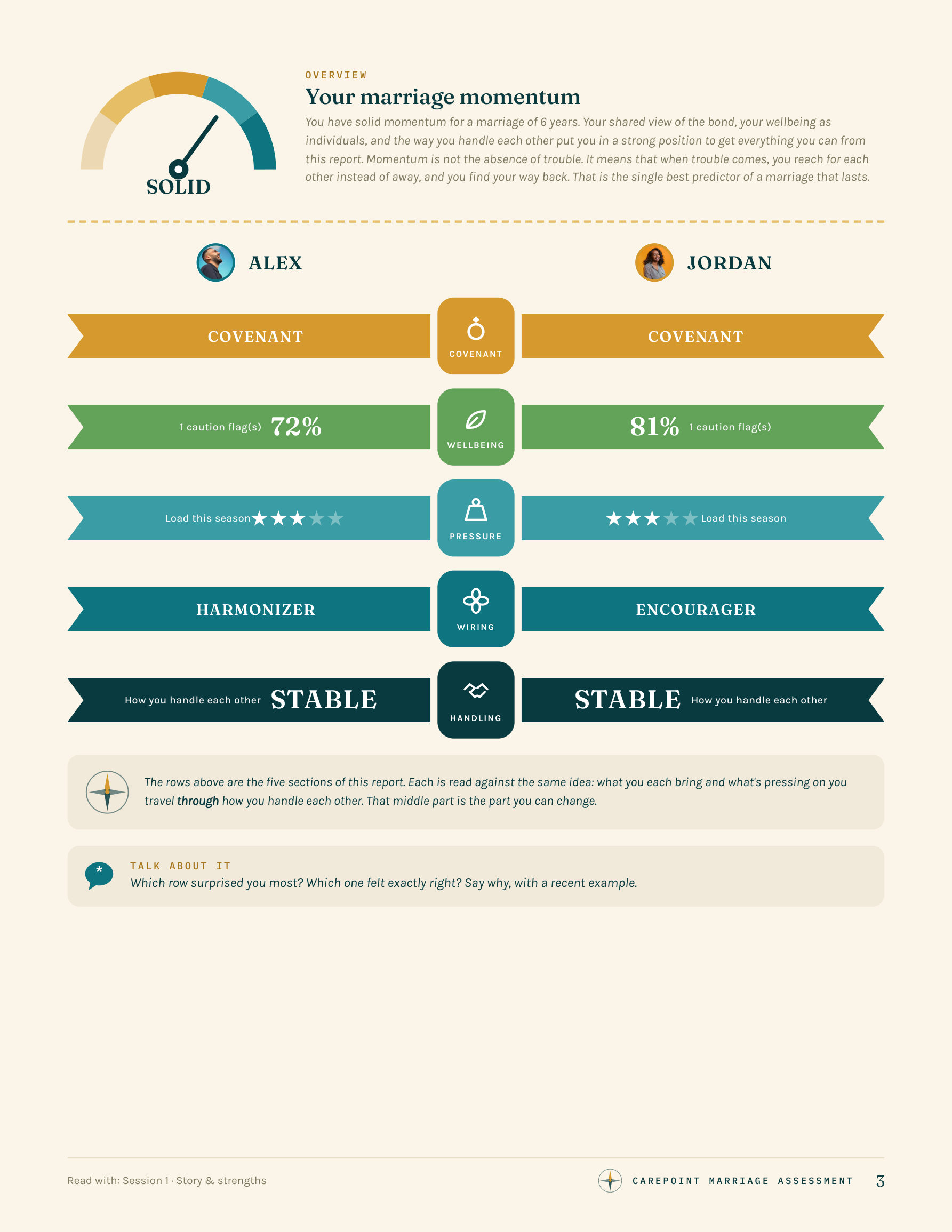
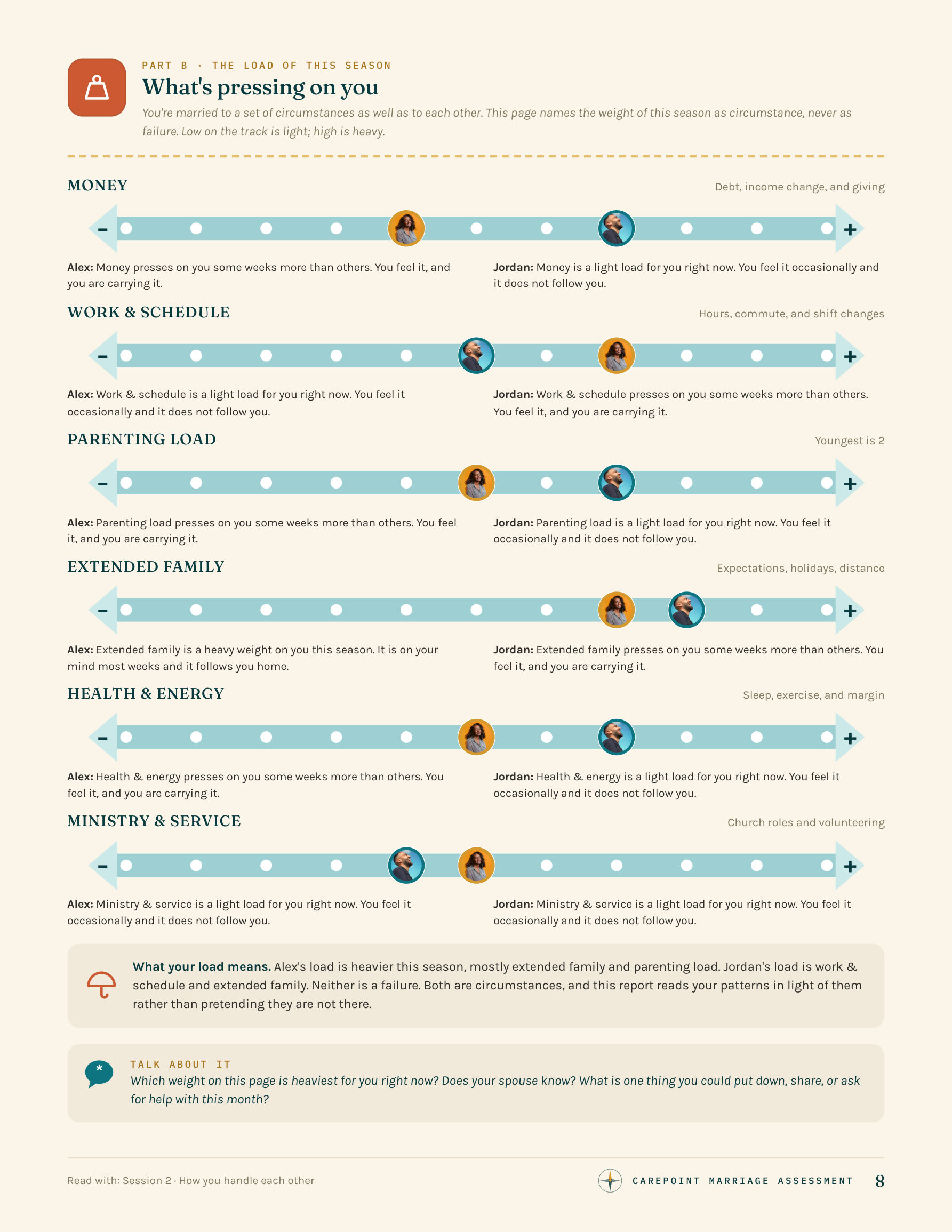
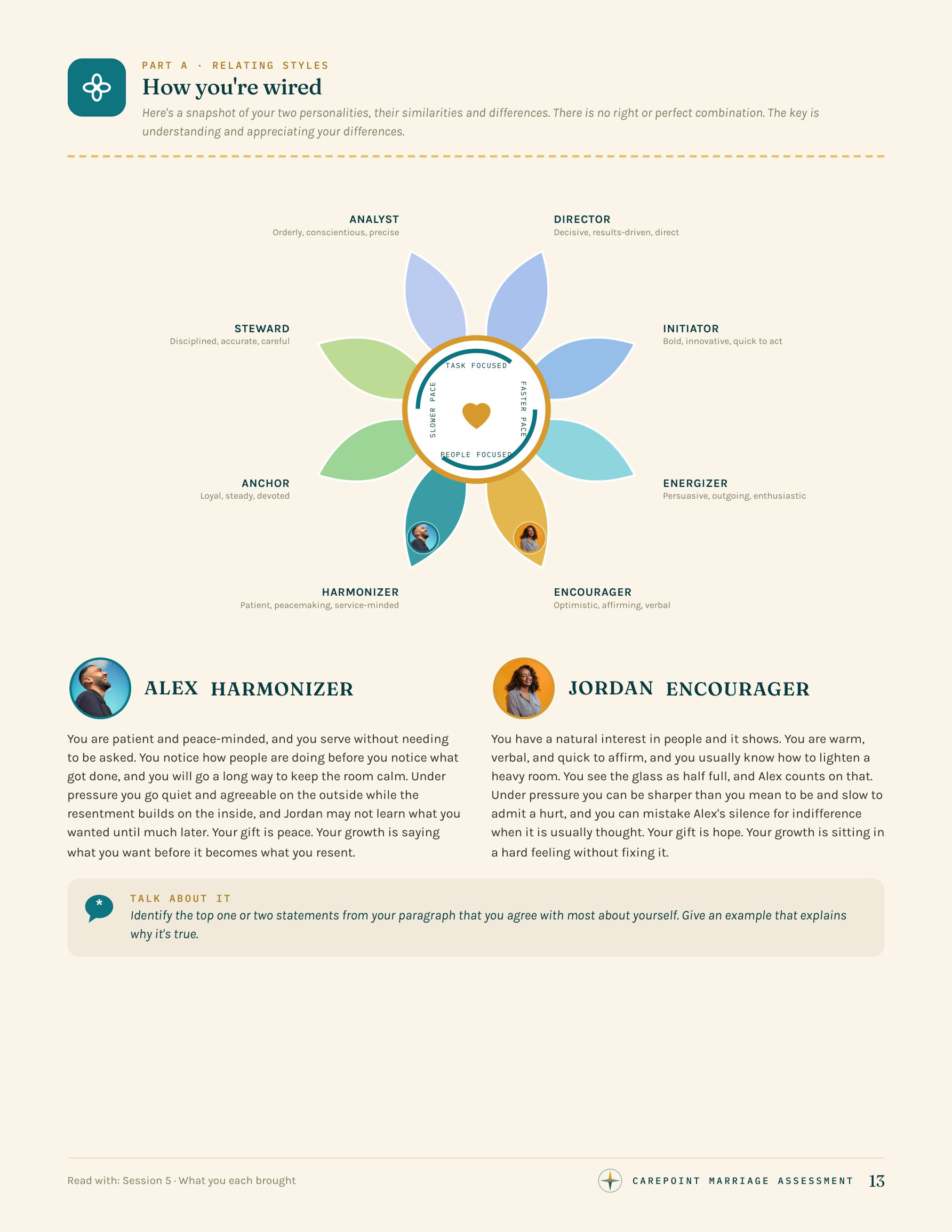
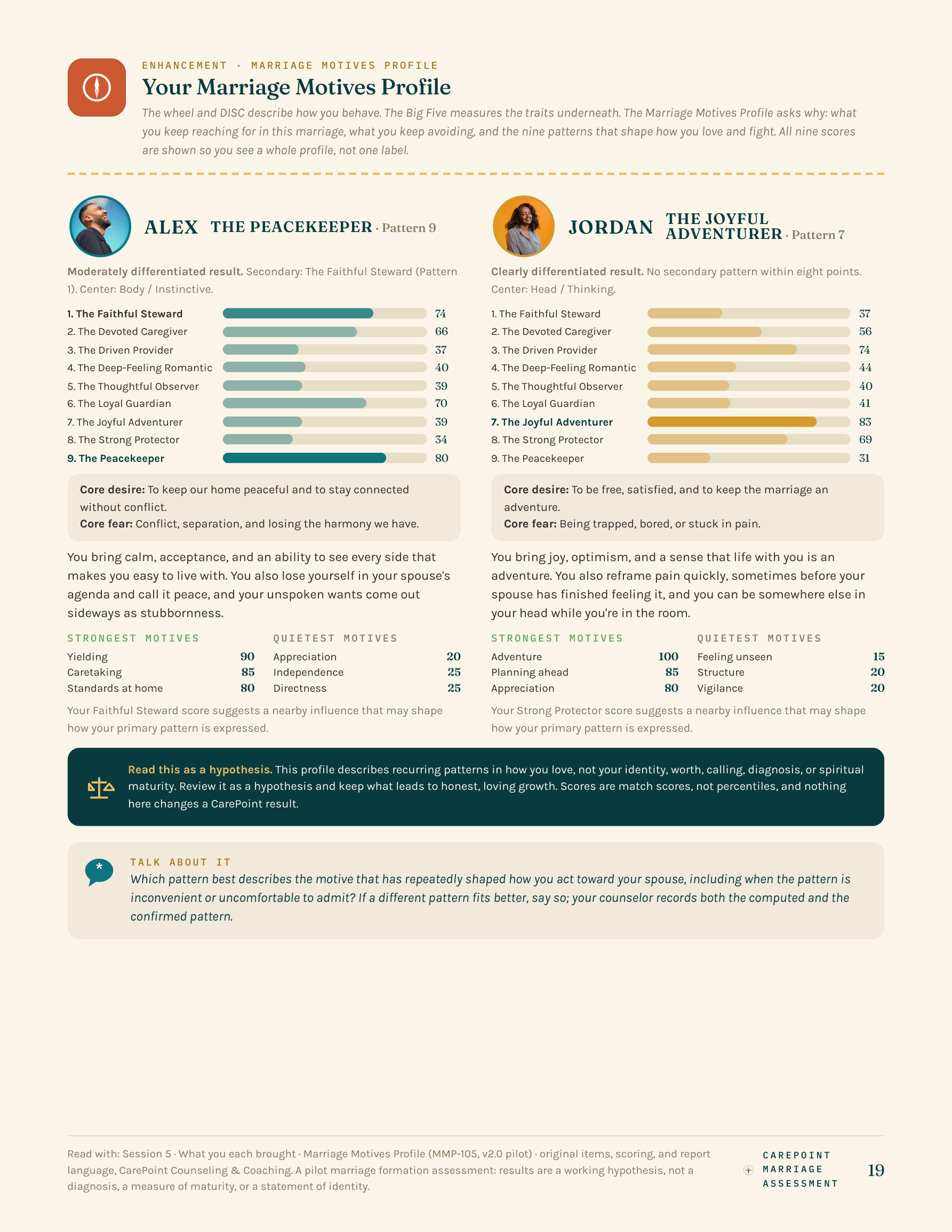
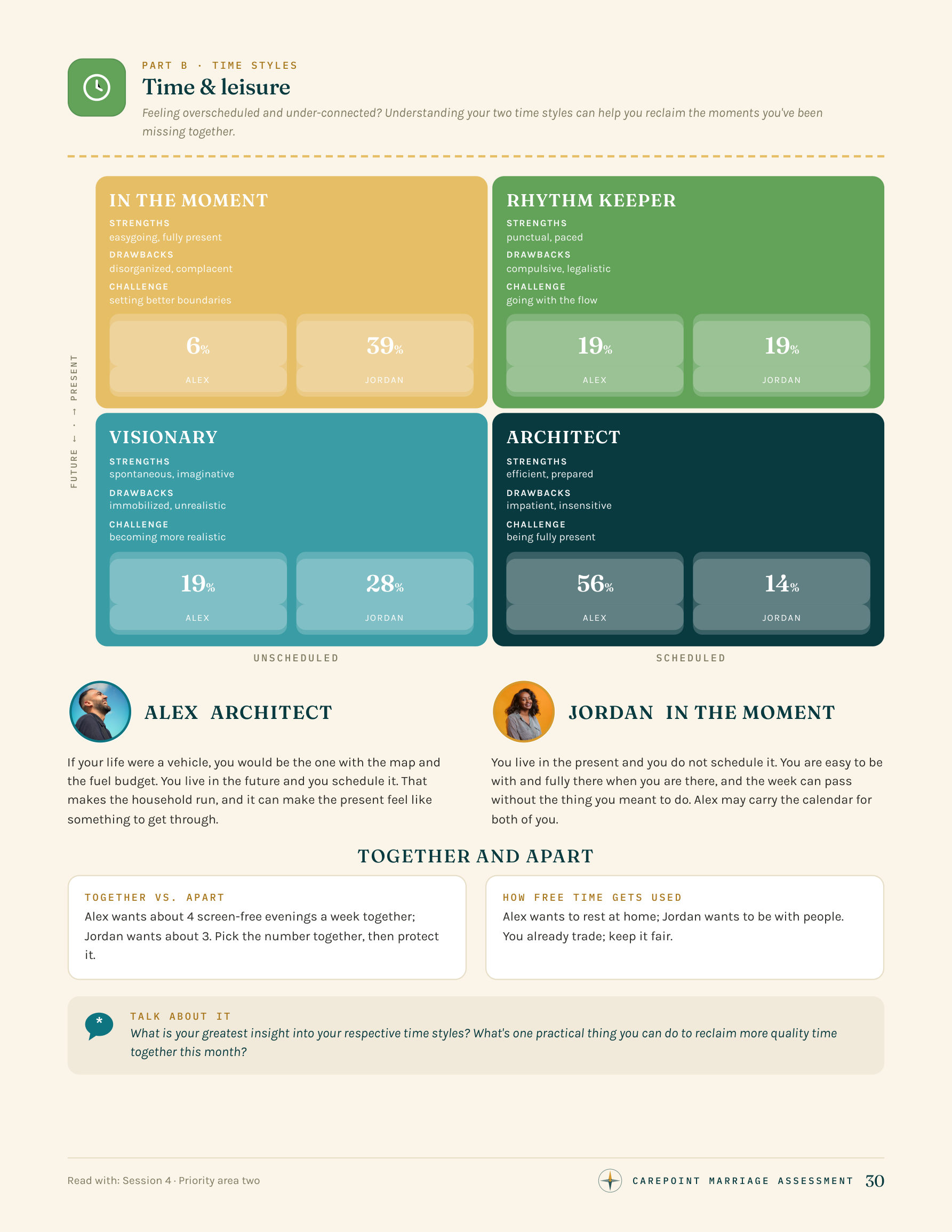
Five pages from a sample couple report. Yours is built entirely from your answers.
Get a full sample report
See all 22 pages for yourself. Enter your name, phone, and email and the full sample couple report is yours to download.
How It Works
A simple process, a guided path
01
Each of you completes it privately
About 45 minutes, on any device, with save-and-resume. You answer independently and honestly — no comparing notes until you sit down together.
02
Your counselor reviews the results
A trained CarePoint facilitator reads the full picture first, so your time together is spent on what matters most, not on decoding a report.
03
You walk through it together — strengths first
Your first session is about your story and what's working. No problem-solving yet. You start from solid ground.
04
You follow a clear path forward
A six-session map, built from your results, that fixes the pattern first and then works through the areas that matter most to you.
Your Path Forward
A six-session map, built from your results
Story & strengths
Review your results together. No problem-solving yet.
How you handle each other
The conflict pattern — fixed first, on purpose.
Priority area one
The area your results point to most.
Priority area two
The next conversation worth having.
What you each brought
Family of origin and history.
Covenant & the plan forward
Shared meaning and where you're headed.
Your counselor can reorder the path to fit you — but it always starts with your strengths and works the pattern before the particulars.
Built on Published Relationship Science
Every scale grounded in peer-reviewed research
The items are entirely original to CarePoint, written to constructs drawn from four bodies of the most respected work in relationship science.
The master framework, which synthesized findings from more than 115 longitudinal marriage studies. Its core insight: history and stress are routed through how a couple copes — so the coping is what you work on.
Karney & Bradbury (1995); Ross et al. (2022)
Olson's decades of work on closeness and flexibility in families — and the reason we score balance, not extremes, on family-of-origin patterns.
Olson (2000, 2011); Fowers & Olson (1986)
Gottman's observational research on how couples start conversations, repair after conflict, turn toward each other, and build shared meaning.
Gottman & Levenson (1992); Gottman & Silver (1999)
Stanley & Markman on dedication and constraint, and Hazan & Shaver on adult attachment — the difference between a marriage freely chosen and one merely held together.
Stanley & Markman (1992); Hazan & Shaver (1987)
Tap any foundation to see the science it's built on.
The CarePoint Marriage Assessment is a pre-pilot instrument designed to the same structural standards as leading clinical inventories. It is a tool for reflection and guided conversation, used alongside counseling — not a diagnostic test.
Your Next Step
Start with a clear picture of the two of you
Reach out for a free consultation. We'll talk through your season, show you what the assessment covers, and help you decide if it's the right next step for your marriage.
CarePoint works with all budgets. Sliding-scale pricing is available. Don't let cost keep you from reaching out.